Alexander Vladimirovich Pyzhikov
Alexander Vladimirovich Pyzhikov (1965–2019)
Historian, Doctor of Sciences, Professor. In 2003–2004, Deputy Minister of Education of the Russian Federation.
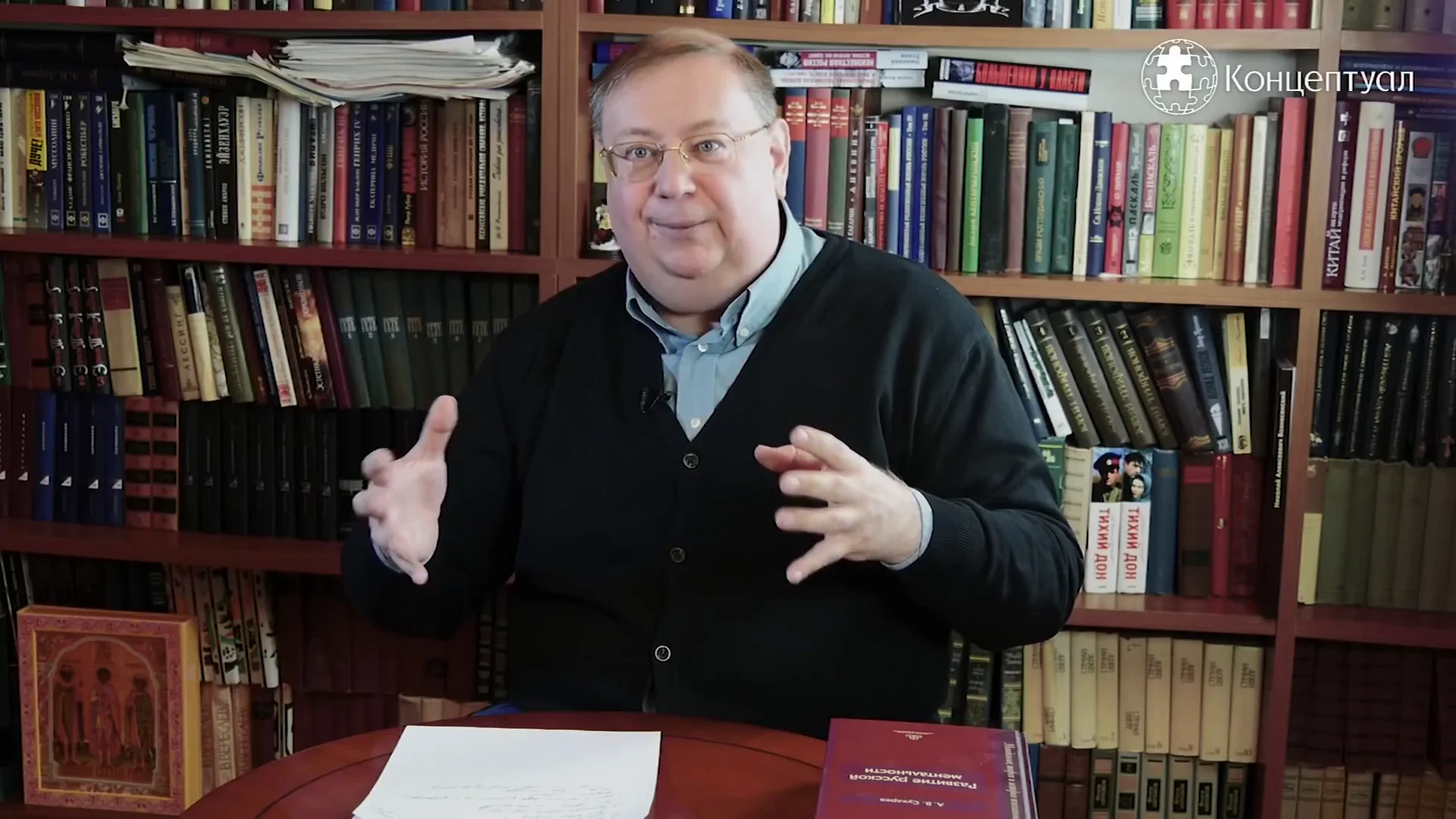
According to Pyzhikov, Russia can find its true path only in its own global project based on an understanding of Russian identity and the deep popular archetype.
Russia is a civilization in search of justice. Its people are truth-seekers who seem driven by an inner necessity to save or liberate someone.
This trait has manifested itself repeatedly throughout history. As early as the mid-nineteenth century, A. I. Herzen saw in the Russian peasant commune the seeds of socialism. He was led to this thought by the defeat of the revolutions of 1848–1849 in Western Europe: having become disillusioned with the West, Herzen began to search for a special path for Russia. Following him, N. G. Chernyshevsky, and later the Populists — P. N. Tkachev, N. K. Mikhailovsky, and others — believed that Russia could arrive at socialism, completely bypassing the capitalist stage. Even Karl Marx seriously entertained this possibility: in his letter to Vera Zasulich (1881) and in the preface to the Russian edition of the 'Manifesto of the Communist Party' (1882).
History, it seemed, refuted these hopes. After the abolition of serfdom, capitalism in Russia developed rapidly, the commune was destroyed, and in 1899 V. I. Lenin in his work 'The Development of Capitalism in Russia' argued that the country had already embarked on a capitalist path. However, as Pyzhikov shows, the communal way of life did not disappear — it went deeper. In many respects, the events of 1917 relied precisely on these communal, especially Old Believer, popular strata. The idea that the Populists associated with the commune returned, but in an unexpected form.
Herein lies the key point: the archetype is only partly eroded by decades and even centuries because it is decentralized. Soviet slogans, by contrast, were centralized: people first believed in them, then stopped, and eventually forgot them entirely. The archetype, on the other hand, is present in everything — in fairy tales, films, jokes; it is literally dissolved in culture and everyday life.
Therefore, even deliberate attempts to rebuild or destroy it do not succeed. The archetype is passed from generation to generation and each time anew gives birth to answers to the questions: how justly, how honorably, how conscientiously. And these answers do not always coincide with how the law prescribes.
Alexander Pyzhikov's most significant books:
'The Facets of the Russian Schism', 'The Roots of Stalinist Bolshevism', 'Peter–Moscow: The Struggle for Russia', 'The Slavic Fracture'.